These are just notes taken during the talk. Nothing structured. Probably an ephemeral post that I'll edit later.
*****
Eye Beam
wikipedia illustrated
visual free culture
launching on Saturday
future everything
Getting intimate with Invisible Audiences
the privacy debate in the context of liveness
two major references
chat roulette & the bible
Today's cultural leaders define the privacy debate
the geeks
for them, it is black and white. Private vs public contradiction
Publicness=a public good. Demanding privacy is selfish
people hold forth for the freedom of information.
Information wants to be free does not translate to freedom in the case of information
free markets do not lead to free societies
Need to get away from the binary thinking about private vs public
secrecy discreteness confidentiality and intimacy are all missing from the debate
Our machines cannot make something intimate, only private and public
The technological failure i good. As long as they cannot be recreated technologically they can't be manipulated
to overcome the tech failure, we are dumbing down our social life.
We give up on secrecy, discreteness, confidentiality and intimacy
communicating in mediated spaces is performance (yes, but relationships exist outside of mediated spaces as well
Hannah Arendt quote about public spaces (squares, etc) but also
Dana Boyd mediated publics-social media sites
4 properties of mediate publics
1. Persistence. It can stay forever on some database (not like the street)
2. Searchability (I wish it was more searchable... sigh)
3. Replicability (can lead to manipulation)
4. Invisible Audiences -- you don't know who is watching or what the context of the watching is in. (This is something I love about mediated publics. It's a huge thrill)
"learn to express themselves and learn" Arendt
Chat roulette
distributed ad-hoc intimacy
Is chat roulette a mediated space?
No persistence, no searchability, no replicability (can't copy paste--wellllll, you can record it easily but it's not a feature of the tool iteslf), and no invisible audience
In chat roulette it is not content, it is conversation.
Hey! He just hit my sweet spot!
I like this guy.
This is the reason I hate Facebook. It's broadcasting over conversation. Also, it's designed to prevent you from talking to strangers, which to me is one of the main purposes of social networks.
Chat roulette is closer to the street. It's a new model of a mediated public.
Chat roulette is a masterbater's paradise. The shuffled conversation lowers the empathy level. You can see but you can't be touched. The audience is protected. Also, CR you are penalized if your are skipped 3 times in the past 5 minutes.
Also a warning that they are violating US and UN law and cooperate with law enforcement, but they do not at all say that it is against CR culture.
Mediation is a violation of chat roulette culture. videoing the screen or taking a screen shot is more a violation of the CR culture than showing your penis. It turns the conversation into content. So sad.
Consider the street (Arendt)
make certain acts or expression real by having others acknowledge them
street is not what it used to be
geo-mobile devices, sensors, geolocated social networking means that everything is
extended manipulated augmented hacked
our physical urban space is being turned into a mediated public. Huge historical change.
face recognition makes our photos searchable
Should we start thinking about life without privacy?
Is privacy irrlevant
privacy not relevant in most pre-technical non-democratic societies (Ian Graham)
Everbody knows everyone else and private and public are fluid.
Adam and Eve hid themselves from God but God called them out. Where are you?
The first thing after they bite from the fruit of knowledge is to realize that they have been exposed to an invisible audience. So they look for privacy and control of their representation.
Creepy paradise.
Am I my brother's keeper?
Cain was about to commit the first perfect crime, except that God saw him. When Cain is asked by God, he feels the invisible audience
we have institutional invisible audiences to protect us from the Cain's of the world
Security frames the privacy debate. What if Google sells its data to the CAI? What about the privacy of Chinese activists? Why do we always come to these big stories? Isn't privacy important for everyone?
I have nothing to hide. If you have something to hide, maybe you shouldn't do it in the first place (Schmidt of Google said)
Good reasons to value privacy
Ham, father of Canaan, sees his drunk father passed out and tells his two brothers outside. Noah gets God to punish Ham by cursing him. Ham took God's invisible audience role
Panopticon
You can't see what goes on in the tower, but you know that you might always be watched.
status of conscious and permanent visibility that assures the automatic functioning of power (Foucault)
lack of privacy causes conformity
Is that true?
What does it mean for walking to become publishing?
Really interesting question. Very pertinent to my work.
How do we continue having intimacy in our new mediated cultures?
These are just notes taken during the talk. Nothing structured. Probably an ephemeral post that I'll edit later.
*****
Electrosmog was a conference last year
early 1980s predictions
paperless office
decentralization of Global Markets
radical reduction of physical mobility
Paperless Office
printing kept up with digital writing, so paper is still used. More paper was produced than ever before. Make sure your predictions take into account all the parallels!
Decentralization
online shops, local distributers.
This works in some ways, but networked technology has in fact made major distributors more efficient and stronger.
The Third Wave bu Alvin Toffler
agricultural
industrial
communicational
electronic cottage-through telecom in the home, we can create a new kind of space where we can both live and work. The original cottage was live and work. The electronic cottage can work in the international stage
Toffler thought it would be adopted everywhere. Free up time for family and social relations. But people find that atll the work connections in the cottage eat up your private sphere and ties you even more into professional processes.
How to get from the global traffic jam to something better?
500 new cars a day are hitting the new big cities every day
there are about 30 of these mid-sized cities in development
in Deli, about 1k new cars appear on the roads
In Nairobi, similar story
Electromagnetic pollution. Cell towers?
Didn't want to stage an event about ecological issues and then fly everyone in, so the premise was no one should travel outside their region. To go to the festival, you have to go to a node in the network.
New Zealand to Canadian Rockies=the network.
second premise=connected conversations
every event has to take place in AT LEAST two locations
also used second life and multiple Skype connections
You would expect the technology to fail, but in fact it worked fine. The crew was experienced and had a 3 or 4 layer deep back up system. Technically it worked great, but still as a festival it had deep, deep problems.
learnings
remote connection works well in an active network.
all nodes connecting in the network have to be active throughout the process, not periodically
Gathering together passive observers did not work (like we had
The remote connection spoiled the local connections. People were in the same space, The events where more people were physically present drew more audience (noth physical and remote). The remote contributions were desperately empty. This was surprising.
Trying to replace the physical presence does not work, but supplementing does.
Why did it fail? He thinks it's because you miss out too much on body language and it doesn't feel like good communication. Physicality matters.
Personally, I also think that people are not yet used to the technology enough yet. Phone calls probably felt very difficult at first and now they feel pretty immediate.
What else was missing?
telepresence denies the libidinal drive for encounter, belonging and identification. Social, emotional, opportunities make us want to come together.
The denial of the physical encounter increases your desire for it.
Coming to a festival or conference makes you feel connected to people in a group you belong to. Telepresence doesn't give you that strongly enough.
I wonder if Vigo will feel this increase in desire. Kids are growing up with a lot more skype and whatnot
Also, it is hard to get laid at a teleconference.
The spectre of Imaginary Media
machines that mediate impossible desires
In fact, bringing people together virtually just makes them want to get on a plane and go see each other all the more. I think that is the summary.
What is the solution?
Accept hybrid and messy solutions
alternative local currencies to slow down movement, sabotage, ecological campaigning, fuel shortages, book reading, natural disasters)
These are just notes taken during the talk. Nothing structured. Probably an ephemeral post that I'll edit later.
****
Philip Auslander
nice baritone voice.
Georgia tech
Digital liveness on Historico-Philosophical perspective
History On the historicity of Liveness
what is considered live performance changes over time as technology changes
The concept of live did not exist before sound recording or film. The concept of live performance depends on the concept of not-live.
good thought.
also requires broadcast networks
1934--first reference to performance as "live" BBC Yearbook.
The confusion of whether something is live or not on radio
when you put on a record, you know what you are doing. It's easy to know that it isn't live.
With radio you can never be sure if you are hearing something live or recorded.
Live and recorded: dichotomy so self evident before that it didn't need to be named
discursive distinction when experiential distinction was lost
But then... live in front of you or live on the radio have no differentiation. That seems odd.
live==physical and temporal
live==temporal (live broadcast)
recorded live==neither, specific performance, vicarious audience, not studio
online liveness-social copresence from chat rooms to audiences waiting for breaking news
group liveness-mobile group of friends in continuous liveness through their phones
liveness is technologically mediated
ideology of liveness...
Margaret Mores
feedback is a machine interacting with you. It gives you a sense of the machines agency, even a persona
A website goes live. The feedback loop makes it live. Liveness doesn't need physical, temporal, or human.
The audiences affective experience. If the thing feels live to us, we value it as live. Is that true?
Philosophical
technological determinism--people create the liveness of technology, not the technology.
He likes to toss the papers he is reading on the ground.
diff digitlal representations make different claims on us.
Claims in a philosophical sense
Gottamer (aesthetic)
analogous to the Gottamar idea
some digital representations demand that we interact with them as if they were live, but then it is up to us to accept or not
computer as social actor paradigm
words for output
response based on prior inputs
filling of roles traditionally held by humans
makes us act toward them AS IF they were social actors
contemporaneous (kirkegaard)
this particular thing that presents itself to us achieves full presence however remote it may be
contemporaneity is not a characteristic of the work or the thing, but of our experience of it.
The temporality of the aesthetic (why we still like old painitings)
the liveness does not come from the machine, but from our willingness to treat the thing as alive. But it does depend on the technology making the demand that concretizes the claim to liveness that we fullfill or don't.
I hate the way this guy writes. Oh, academia, why do you write so crappily? Why do you love the 4-syllable word?
mindlessness accounts for our tendency to interact with machines as if they were human even though we know they are not. But this is also technological determinism.
My personal opinion (me Tracy) is that we accept technology as live because we like to. Also, it's a lot easier for us. We're used to dealing with things that are alive.
Auslander's summary of his argument:
some tech object makes a claim on its audience to
concretized as a demand by some way it presents itself
if we accept the claim and take it seriously, it becomes live for us
not characteristic of the object
not characteristic of the way the object presents itself
characteristic of our acceptance of the object
Back in 1997, purely by chance, I caught the National Spelling Bee on ESPN. It was one of the most intense things I had ever seen and every once in a while I think again about Rebecca Sealfon. Watching this child lurching on the edge of total psychotic break down for well over an hour was fascinating, funny, terrifying, and voyeuristically satisfying.
The best part of the spectacle was when Rebecca wins and she gets to speak to the cameras. She says that she wanted to win this year so she could say that there shouldn't be a bee.
I'm still not sure what exactly it is about this neurotic little soul that I'm so attracted to. Partly, it's the catharsis of watching her emotions. There they are! She's ecstatic. She's terrified. She's relieved. She's an open story, but alien at the same time. I almost cried re-watching the spelling of euonym and her little speech today.
The winning word:
I had a fun argument the other night with Jay Cousins, from Open Design City. He innocently said, "Everyone is an artist," and I felt compelled to contradict. (Full disclosure: I was a little bit drunk.)
Cultures define for themselves what kinds of stuff they want to call art. Individuals in the culture do the same for themselves. The definitions shift. I think what Jay was really getting at is that we should be more fluid in our perception of art, more accommodating to new ideas of what art is, and more nurturing of creativity in general. This is the mission of the ODC and they do great work.
Definitions of what is art should be elastic--or better yet, abandoned--but the idea that art can come from anywhere does not mean that every person has a dormant artist inside just waiting to blossom.
And thank heavens not.
When people say that everyone is an artist, it's usually a form of anthropological narcissism. Everyone want to be the norm. Humans have been fixated on the idea of human nature at least since culture has existed. Usually, the people who are out to define what it is are doing their damndest to prove that human nature is what they feel is natural themselves. Especially the evolutionary anthropologists.
The human condition is a paradox. On the one hand, humans need connections to other humans. We spend our lives trying to communicate with and understand each other deeply. On the other hand, we can never truly know the mind of anyone else. We can never be really sure that the person in front of us even understands the words we are using in the way we mean them. Do they see the same colors? Do they smell the same smells? Do the smells smell the same?
Our need for connection leads us to want to believe that we are somehow all the same. That there is a human nature common to us all. That there are traits you can find in everyman. I'm starting to think that this is probably not true. Other people are more different from us than we think.
The highlight of the Transmediale opening night on Tuesday was Ei Wada's performance of original music played on old television sets. I would love to see how he composes his music. It's always interesting to see alternative musical notation for unconventional instruments. Actually, it is just as interesting to see alternative musical notation for conventional instruments.
Ars Electronica describes the piece: "Japanese experimental artist Ei Wada breathes new life into old TV picture tubes. He utilizes their ectromagnetic properties to transform light into sound and back again. When he touches the screens, this triggers a fascinating audio & video performance in which his hands and his whole body serve as pseudo-antennas. The old-fashioned picture tube TVs and a video recorder become percussion instruments, light synthesizer and VJ/DJ equipment all rolled into one. Thus, devices that have lost their original function can be used in a new way."
I'm not sure why he is described as a pseudo-antenna. Isn't his body a real antenna? I don't really understand how this works. I am looking forward to getting a very detailed explanation from someone who does.
Here's a video I took from my phone of the first two songs. It's a bit long, but you can get a good idea of what is going on here if you watch the first minute or two.
Ei Wada's blog is mostly in Japanese.
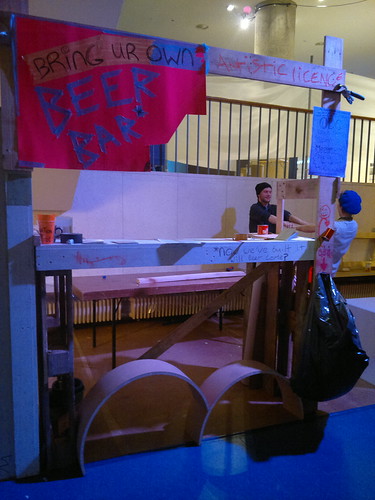
Open Design City has a nice Transmediale presence. One of my favorite things they've done is the Bring Your Own Beer Bar and DIY sandwich stand. I brought them some rolls and cheese this morning and I plan to go redeem my sandwich soon. I had enough to drink at the opening last night, so I didn't bring any beer today. Maybe tomorrow.
Vigo hung out there most of the evening last night, and partook of several peanut-butter sandwiches.